Skip to content

Landscaping SEO: How to Rank in Your Local Market Year-Round

Landscaping is a seasonal business. Your SEO does not have to be. Here is how to build Google visibility that generates leads in every month of the year.

Most landscaping companies treat their marketing like they treat their slow season: they get quiet and hope things pick back up in spring. In April and May the phone rings on its own because everyone wants their lawn looking good and their beds cleaned up, so there is a temptation to believe that is just how the business works. Seasonal demand in, seasonal revenue out.

But that thinking is exactly what keeps landscaping companies stuck in a cycle of feast-and-famine instead of building something more predictable.

Google does not take a winter break. Homeowners searching for landscaping services in January are planning ahead. Homeowners searching in October want fall cleanup or a snow removal contract before the first storm hits. And homeowners searching in June want someone who is already established in their area, trustworthy, and available, which means the landscaping company that was working on its Google presence in February has a head start on every competitor that turned off its marketing when the leaves fell.

This guide covers landscaping SEO from the ground up, with specific attention to the challenges that are unique to this industry: managing an enormous breadth of services under one brand, competing against solo operators with almost no overhead, fighting seasonal search volume swings, and building the kind of recurring-client pipeline that transforms a landscaping company from a job-by-job hustle into a stable, scalable business.

Why Landscaping SEO Is More Complex Than Most Home Service Categories

At first glance, landscaping SEO looks straightforward: show up when homeowners search for lawn care or landscape design in your area. But the reality is significantly more complex, for reasons that are specific to how landscaping businesses are structured and how homeowners search for landscaping services.

The Service Breadth Problem

A roofing company does roofing. A plumber does plumbing. A landscaping company might do lawn mowing, fertilization, aeration, overseeding, mulching, bed maintenance, pruning, tree trimming, hardscape installation, paver patios, retaining walls, landscape design, irrigation installation, irrigation repair, drainage solutions, sod installation, hydroseeding, holiday lighting, and snow removal, all under the same brand.

Each of those services has its own keyword set. Each attracts a different type of homeowner with a different level of urgency and a different buying timeline. A homeowner searching for a patio installation quote is in a completely different mindset than one searching for weekly lawn mowing service. Your SEO strategy has to account for all of these service types, their different audiences, and their different conversion behaviors, without creating a website so sprawling that Google cannot figure out what you are actually best at.

The solution is deliberate structure: service pages organized into logical categories, location pages that reference the full range of services, and content that helps homeowners self-select into the right service for their needs.

The Recurring Revenue Opportunity

No other home service category has the recurring contract model that landscaping does at this scale. A lawn care client who signs up for weekly service is not one job. They are 25 to 30 visits per year, year after year, with predictable revenue that transforms your business from unpredictable to stable. A snow removal commercial account provides reliable winter income that offsets the seasonal revenue drop for companies in northern climates.

This recurring revenue dynamic should shape how you think about landscaping SEO. You are not just trying to attract one-time project customers. You are trying to attract homeowners and property managers who become long-term accounts worth thousands of dollars per year over multiple seasons. A single recurring lawn care client acquired through organic search might be worth $2,500 to $4,000 or more over the course of a multi-year relationship. The lifetime value calculation makes even significant SEO investment look attractive when modeled accurately.

Lawn care companies whose business is built around maintenance rather than installation have a distinct SEO approach. See our lawn care company SEO page for the recurring contract content strategy specific to that model.

The Competition Spectrum

In HVAC or plumbing, you compete primarily against other established companies. In landscaping, you compete against an enormous range of operators: solo guys with a truck and a mower who undercut on price, regional franchise networks with brand recognition and marketing budgets, large commercial landscaping firms that occasionally do residential work, and dozens of other small to mid-size local companies at various stages of professionalization.

The SEO playing field in landscaping is correspondingly wide. Solo operators rarely have any web presence worth mentioning. Franchise networks have brand authority but generic local execution. The window for a well-run independent landscaping company to dominate local search is real and often larger than business owners expect, because most landscaping competitors have mediocre or ignored online presences regardless of how good their actual work is.

Google Business Profile Optimization for Landscaping Companies

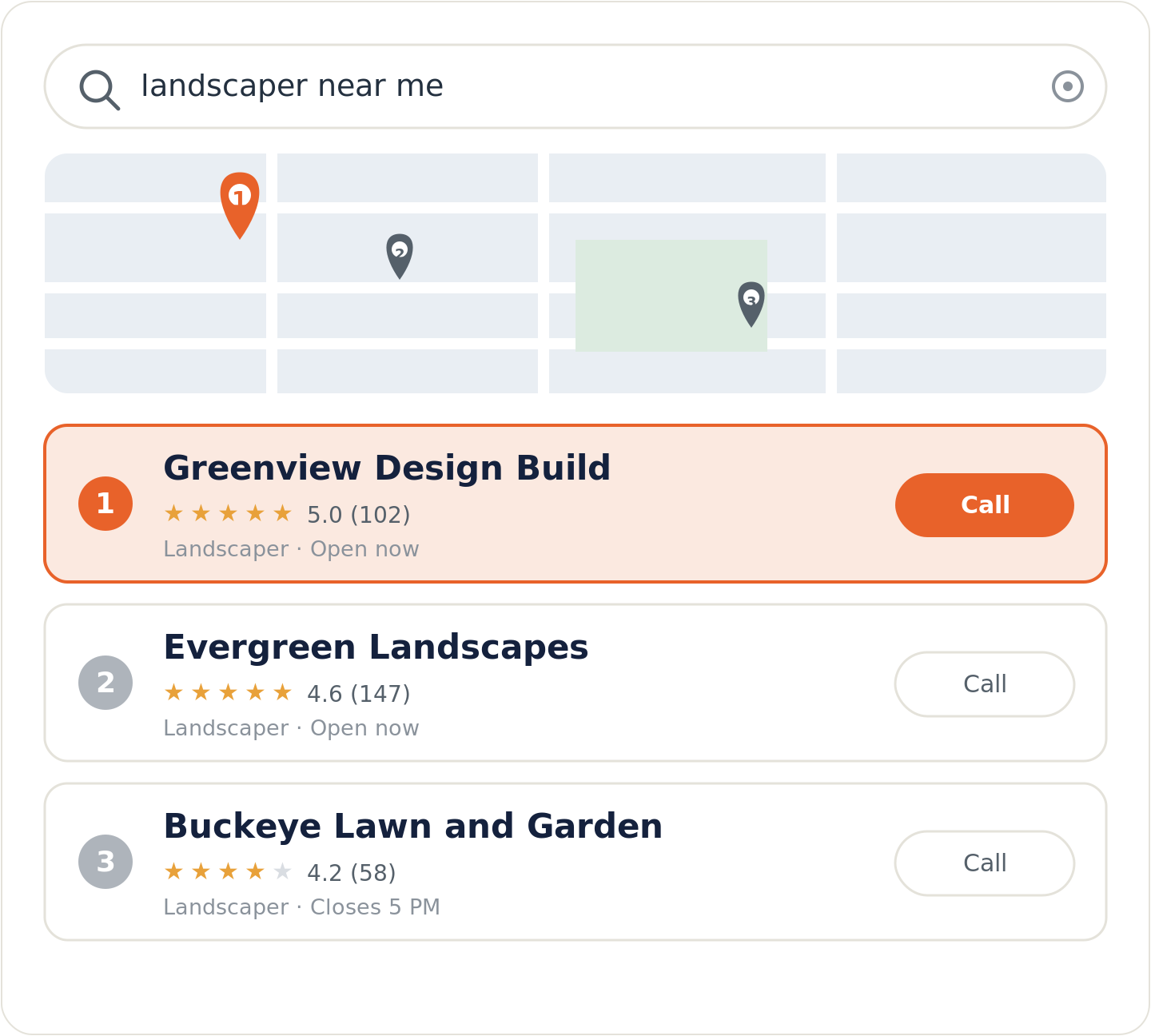
The Google Business Profile is the foundation of your local SEO strategy and the primary driver of map pack visibility. In landscaping, the GBP plays a specific and important role: it is where homeowners verify that your company is real, established, and well-reviewed before they decide whether to fill out a quote form or call.

Most landscaping companies have a claimed GBP with incomplete information and a handful of photos from two years ago. That baseline is the minimum, not the standard. Here is what a genuinely optimized landscaping GBP looks like.

Categories and Primary Classification

Your primary GBP category should match your primary business focus. “Landscaper” is the broadest appropriate category and works well for full-service companies. If lawn care maintenance is your core business, “Lawn Care Service” may be more appropriate. If landscape design and installation is the focus, “Landscape Designer” or “Landscape Architect” depending on your credentials may be worth testing. Add secondary categories for every major service you provide: Snow Removal Service, Irrigation Service, Hardscape Contractor, Tree Service, Garden Center if applicable, and so on. Each secondary category expands the search terms for which your profile can appear.

Service Area Configuration: Think Neighborhoods, Not Just Cities

Landscaping companies often serve a tighter radius than HVAC or plumbing companies because of travel time and fuel costs per job. But within that radius, you likely serve multiple distinct cities, towns, and suburbs. Add all of them to your service area configuration in Google Business Profile.

One nuance specific to landscaping: neighborhoods matter more in this category than in most. A homeowner in a specific upscale subdivision is more likely to search “landscaper in [subdivision name]” or “landscaper near [local landmark]” than a general city-level search. Including well-known neighborhood and community names in your GBP description and service pages can capture this hyperlocal search behavior that most competitors miss entirely.

The Photo Strategy: Your Work Is Your Best Marketing

Landscaping is perhaps the most visually purchase-dependent home service category in existence. A homeowner deciding whether to hire you for a patio installation or a landscape design project wants to see what your completed projects look like before they will even consider a quote conversation. Your GBP photo library is the fastest way to create that visual evidence of quality.

What to include and how much:

  • Completed hardscape projects, paver patios, retaining walls, outdoor living areas, fire pit installations: these command the highest job values and the best photos here convert at the highest rates
  • Landscape design and installation transformations: before and after pairs are especially powerful for showing the magnitude of the change your work creates
  • Lawn care results: tight, clean mowing patterns, well-edged beds, freshly mulched areas that look cared for and professional
  • Seasonal work: fall cleanup before and after, spring bed preparation, winter holiday lighting if you offer it
  • Your equipment and crew: branded trucks and trailers, uniformed team members, and any specialized equipment that signals you are a professional operation rather than a solo operator
  • Residential vs. commercial: if you do both, include examples of each so the right prospect can picture their own property in your portfolio

Aim for a minimum of 50 photos before considering the baseline met. Add new project photos throughout the active season, at least weekly during spring and summer. GBP photo activity is a freshness signal that Google factors into local ranking, and a landscaping company whose photo library is growing every week signals active operation in a way that a static portfolio never can.

Reviews: Building the Trust That Wins Recurring Contracts

For landscaping, the review strategy has a layer of complexity that other trades do not: you want reviews that speak not just to quality of one-time project work but to ongoing reliability as a maintenance partner. A homeowner considering a weekly lawn care contract is asking a different trust question than one getting a single mulch installation. Reviews that mention consistent service, good communication, showing up on schedule, and professionalism across multiple seasons are especially persuasive for the recurring maintenance side of your business.

Build your review system with the same process that works across all trades: ask at job completion in person, follow with a direct-link text, respond to every review publicly. In landscaping, the addition of seasonal follow-up requests makes sense: sending a review request at the end of the lawn care season to long-term clients who have never left one is a natural and appropriate touchpoint that generates reviews describing multi-year experiences.

The Year-Round Keyword Strategy: How to Stay Visible in Every Season

The title of this guide promises year-round rankings, and that requires a year-round strategy. The core insight is that different landscaping services peak at different times of year, and the SEO work that generates spring and summer leads needs to be done the previous fall and winter. Here is what that looks like across the full calendar.

Spring (Mar-May)

  • Lawn cleanup
  • Lawn fertilization
  • Mulch installation
  • Bed cleanup
  • Landscape design
  • Sod installation
  • Overseeding

Summer (Jun-Aug)

  • Lawn mowing
  • Lawn care service
  • Irrigation repair
  • Landscape maintenance
  • Tree trimming
  • Weed control
  • Landscaper near me

Fall (Sep-Nov)

  • Fall cleanup
  • Leaf removal
  • Aeration and overseeding
  • Irrigation winterization
  • Snow removal contracts
  • Retaining wall installation

Winter (Dec-Feb)

  • Snow plowing
  • Snow removal
  • Commercial snow removal
  • Winter landscaping
  • Landscape design planning
  • Hardscape quotes

Understanding this seasonal pattern allows you to time your content publishing and optimization around the demand curve rather than in response to it. An article about fall cleanup and leaf removal published in late August will have 6 to 8 weeks to be indexed and start ranking before that search volume peaks in September and October. A snow removal services page optimized in October will be well-established by November when homeowners start thinking about winter contracts.

The landscaping companies that rank year-round are not lucky. They are thinking 60 to 90 days ahead of the season and building their Google presence before the demand arrives.


Want us to build this keyword strategy for your landscaping business? Get a free audit and see exactly where your biggest seasonal opportunities are. → REQUEST AUDIT

Bridging the Slow Season with SEO Content

January and February represent the lowest search volume period for most landscaping services in cold-weather climates. But they are also the highest-value period for SEO investment, because any content you build or optimization you do in these months will be fully indexed and ranking by the time spring search volume explodes in March and April.

Use the slow season to build:

  • Landscape design inspiration content and cost guides that attract homeowners planning spring projects
  • New location pages for suburbs and towns you want to expand into
  • Service pages for any services you offer that do not yet have dedicated pages
  • Blog content targeting spring and summer search terms so it has time to rank before demand peaks
  • Technical site improvements: page speed, mobile optimization, schema markup, and any technical SEO issues flagged in your audit

A landscaping company that uses its February downtime to build 10 new content assets will enter spring in a dramatically stronger ranking position than a competitor that went dark from November through March. This is one of the most actionable and underexploited advantages in landscaping SEO.

Need help growing your landscaping business with SEO. See how we help landscapers and hardscape companies rank in the Top 3 for their most profitable service areas.

Building a Landscaping Website That Ranks for Every Service You Offer

The breadth of services that landscaping companies offer is both the biggest opportunity and the biggest structural challenge in landscaping website SEO. Done correctly, your website can rank for dozens of distinct service searches across your entire service territory. Done incorrectly, it is a sprawling site that Google cannot categorize, that potential clients cannot navigate, and that ranks for almost nothing.

The solution is deliberate information architecture: a clear hierarchy of service categories, individual pages for every specific service within each category, and location pages that connect your services to every geographic area you serve.

Service Category Structure: How to Organize the Full Range

Most landscaping companies offer services that fall into distinct categories. Building your website around these categories creates a logical structure that both Google and homeowners can navigate:

  • Lawn Care and Maintenance: Lawn mowing / Weekly lawn care service / Fertilization and weed control / Aeration and overseeding / Lawn renovation / Grub treatment
  • Landscape Design and Installation: Full landscape design / Planting and bed installation / Sod installation / Hydroseeding / Seasonal color installation
  • Hardscape Installation: Paver patio installation / Retaining walls / Walkways and pathways / Outdoor kitchens / Fire pits and fire features / Driveway pavers
  • Trees and Shrubs: Tree trimming and pruning / Shrub trimming and shaping / Tree removal / Stump grinding / Plant health care
  • Irrigation: Irrigation system installation / Irrigation repair and maintenance / Drip irrigation / Irrigation winterization / Smart irrigation controllers
  • Cleanup and Seasonal Services: Spring cleanup / Fall cleanup / Leaf removal / Mulch installation / Bed edging and maintenance
  • Snow and Ice Management: Residential snow plowing / Commercial snow removal / Ice management / Seasonal snow removal contracts
  • Specialty and Add-On Services: Holiday lighting / Drainage solutions / Landscape lighting / Outdoor living spaces / Commercial landscaping

Each individual service in that table should have its own dedicated page. Not a section on a page, but its own URL with its own title, its own keyword-targeted content, and its own call to action. A page for paver patio installation that goes 800 words deep on the process, materials, design options, typical costs, and what to expect during installation will rank for paver patio searches. A sentence on a general “Hardscape” page will not.

Location Pages: Covering Your Full Service Territory

If your landscaping company serves 15 towns and suburbs, you should have a page for each one. These location pages serve two critical functions: they give Google geographic signals that connect your services to specific communities, and they capture homeowners who search with city or neighborhood modifiers rather than “near me.”

The most common mistake landscaping companies make with location pages is creating thin templates that just swap in the city name. A location page that actually ranks needs to be a genuine resource for homeowners in that specific community. Reference local context where you authentically can: the typical lot sizes and landscaping styles in that area, any community HOA requirements that affect landscaping choices, local climate micro-differences if relevant, and any notable projects you have completed in that neighborhood. Even a sentence or two of genuine local specificity makes a location page meaningfully more effective than a pure template.

The Visual Portfolio: Turning Your Website Into a Lead Conversion Engine

For landscaping companies, a strong photo portfolio is not optional. It is one of the primary conversion mechanisms on your website. Homeowners deciding whether to request a quote are making a visual judgment about whether your aesthetic matches theirs and whether your quality level is appropriate for their property. No amount of text can do what a gallery of stunning completed projects can.

Structure your portfolio around the decision questions homeowners are actually asking:

  • Organize project photos by service type so a homeowner looking for patio inspiration can browse patio projects specifically rather than hunting through a general gallery
  • Include project details with each photo set: approximate project size, materials used, and the general geographic area of the project. This helps homeowners who are in the quoting stage understand what drives pricing.
  • Feature transformations prominently. The most powerful visual proof in landscaping is before and after: a neglected or bare yard transformed into a professionally designed space. These sequences communicate value more effectively than any finished-only photo can.
  • Include captions that describe what made each project distinctive: a challenging grade that required creative terracing, a shady area that needed specific plant selections, a tight space that required custom stonework. These details demonstrate expertise to homeowners who care about quality.

Landscaping Keyword Strategy: Targeting the Full Spectrum of Search Intent

Landscaping keyword research is more expansive than most home service categories because of the sheer breadth of services involved. But not all keywords carry equal value, and a smart strategy prioritizes based on search volume, competition level, and the value of the jobs those keywords attract.

High-Value Project Keywords

These searches represent homeowners looking for significant one-time project work: the most profitable jobs in the landscaping portfolio. They have lower search volume than maintenance keywords but higher individual job values and are worth investing significant page optimization effort to capture. Pool installations often overlap with the outdoor living and hardscape projects landscaping companies take on. The SEO strategy for pool companies follows the same high-ticket visual buyer logic.

  • “paver patio installation [city]” / “patio contractor near me”
  • “retaining wall installation [city]” / “retaining wall contractor”
  • “landscape design [city]” / “landscape designer near me”
  • “outdoor kitchen contractor [city]”
  • “sod installation [city]” / “sod company near me”
  • “landscape renovation [city]”
  • “hardscape contractor near me”
  • “outdoor living space contractor [city]”

Recurring Service Keywords

These searches represent the highest lifetime value leads a landscaping company can attract: homeowners looking for ongoing maintenance relationships rather than one-time projects. Lower individual job value but dramatically higher total revenue per client over time.

  • “landscaping company near me” / “landscaper near me”
  • “lawn care service [city]” / “lawn mowing service near me”
  • “lawn maintenance company [city]”
  • “weekly lawn mowing service near me”
  • “full service lawn care [city]”
  • “commercial landscaping company [city]”
  • “property maintenance company near me”
  • “landscape maintenance [city]”

Seasonal and Specific Service Keywords

These searches spike at specific times of year and require content built and optimized before the season arrives:

  • “fall cleanup [city]” / “leaf removal service near me” (peaks September through November)
  • “spring yard cleanup [city]” / “spring cleanup service” (peaks February through April)
  • “snow removal service [city]” / “snow plowing near me” (peaks October through December for contracts)
  • “aeration and overseeding [city]” (peaks August through October)
  • “irrigation startup near me” / “sprinkler system startup [city]” (peaks March through May)
  • “mulch installation [city]” / “mulching service near me” (peaks March through June)

Research and Planning Keywords

These searches come from homeowners early in the consideration process and are best served by blog content rather than service pages. They convert more slowly but build topical authority and brand recognition:

  • “how much does a paver patio cost” / “paver patio cost [city]”
  • “how much does landscaping cost” / “landscaping cost per square foot”
  • “best plants for [climate type] landscapes”
  • “low maintenance landscaping ideas”
  • “backyard landscaping ideas on a budget”
  • “what time of year is best to aerate your lawn”
  • “how to choose a landscaping company”

Winning Recurring Maintenance Contracts Through SEO

Most landscaping SEO guides treat every lead as a transaction: a homeowner searches, finds your company, gets a quote, and either becomes a customer or does not. But the most valuable clients in landscaping are not transactions. They are relationships, recurring maintenance customers who hire you season after season with predictable annual revenue that compounds into a stable book of business.

Building an SEO strategy specifically designed to attract recurring maintenance clients, not just project inquirers, requires thinking about what those homeowners search for and what they need to see to feel confident committing to an ongoing relationship.

What Recurring Maintenance Clients Search For

Homeowners looking for ongoing lawn care or landscape maintenance are often searching differently than those looking for a one-time project. They want a reliable partner, not just a vendor. Their searches reflect this:

  • “reliable lawn care service [city]” and “trusted landscaping company [city]” include trust signals in the query itself
  • “lawn care contract [city]” and “seasonal lawn care service” indicate a homeowner who has already decided they want an ongoing relationship
  • “commercial landscaping maintenance [city]” attracts property managers and commercial accounts who are almost always recurring relationships
  • “full service lawn care” signals a homeowner who wants to hand off the entire lawn maintenance responsibility, not just mowing

Your service pages targeting these keywords should be written with the recurring relationship in mind. Emphasize your communication process, how you handle scheduling and rescheduling, your approach to seasonal transitions, and how long your average client has been with your company. A homeowner looking for a lawn care partner wants to know that you will be reliable and consistent, not just that you know how to mow a lawn.

Seasonal Contract SEO: Getting Snow Removal Clients Before the Snow Falls

Snow removal is the single most time-sensitive content opportunity in landscaping. Homeowners and commercial property managers who want snow removal contracts do not start looking in December when the first storm is forecast. They start looking in September and October while there is still time to compare companies and sign contracts before the season begins.

A landscaping company in a cold-weather market that publishes well-optimized snow removal content in August and September, and runs GBP posts promoting their contract availability, will accumulate snowplow clients while competitors are still focused on the final weeks of the mowing season. By November when everyone wants snow removal, your calendar is full and you are turning people away rather than scrambling for last-minute accounts.

This same principle applies to other seasonal service offers: aeration and overseeding contracts booked in summer, holiday lighting installation scheduled in early October, spring startup packages sold in February. The landscaping company that thinks ahead in its SEO content strategy fills its calendar before demand peaks. The one that reacts when demand peaks fights for scraps.

Using Service Agreement Pages to Build SEO and Convert High-Value Clients

Most landscaping companies do not have a dedicated page explaining their service agreement or annual maintenance program structure. This is a missed opportunity on two fronts: it leaves homeowners without the information they need to commit to a recurring relationship, and it misses a content opportunity to rank for searches like “lawn care service agreement [city]” and “annual landscape maintenance program.”

A well-written page that explains what is included in your maintenance program, how pricing is structured, how communication works, what your cancellation policy is, and what makes your ongoing service relationship different from a company that just shows up and mows without thinking about the long-term health of the property is a powerful conversion tool for the highest-value segment of your market.

Building Local Authority for Your Landscaping Company

Local authority in SEO is built through the combination of consistent business information across the web, quality backlinks from trusted local sources, and the accumulation of reviews and engagement signals that tell Google your business is legitimate, established, and trusted by real customers. In landscaping, where the local competitive field is crowded with operators at various levels of professionalization, building genuine local authority creates a durable ranking advantage.

Citation Consistency Across Directories

Your business name, address, and phone number must appear consistently across every directory, review site, and online listing. For landscaping companies, the most important directories to establish and maintain include:

  • Google Business Profile (primary)
  • Bing Places for Business and Apple Maps
  • Yelp and Houzz (especially important for design-oriented landscaping companies)
  • Angi (Angie’s List), HomeAdvisor, and Thumbtack
  • Better Business Bureau
  • Local Chamber of Commerce
  • Nextdoor (particularly effective for residential landscaping because it is neighborhood-specific by design)
  • Lawn and garden specific directories and association member listings if you belong to NALP or state landscaping associations

Run a citation audit annually to find and correct any inconsistencies in your business name, address, phone number, or website URL across these directories. The standard is not just having a listing but having the right listing everywhere.

Nextdoor: The Underused Platform for Residential Landscaping

Nextdoor deserves special attention in landscaping because it functions differently from every other directory or review platform. It is neighborhood-specific and neighbor-recommendation-driven, which makes it uniquely well-suited to the word-of-mouth dynamic that residential landscaping has always relied on. A landscaping company with strong Nextdoor reviews and active recommendations in a neighborhood can dominate that neighborhood’s informal marketing without running a single ad.

Encourage satisfied clients to recommend your services on their neighborhood Nextdoor page. Ask for it explicitly the same way you would ask for a Google review. A single enthusiastic recommendation from a neighbor to 400 connected households in a subdivision is worth more for generating calls in that neighborhood than almost any other marketing activity at a comparable cost.

Backlinks from Local Sources

Backlinks from relevant, locally trusted websites are one of the strongest authority signals in local SEO. For landscaping companies, the most practical sources of quality local backlinks include:

  • Local Chamber of Commerce membership, which typically includes a directory listing with a link
  • Home builder and developer partnerships: if you provide landscaping for new developments, the builder’s website or project portfolio may include a link to your site
  • Real estate agents who refer landscaping companies to home sellers preparing properties for market
  • Local garden centers, nurseries, or plant suppliers who list preferred installers or landscaping partners
  • HOA and community association websites that list approved or recommended vendors
  • Local news coverage of notable projects, community involvement, or award recognition
  • Industry association member pages: NALP, state landscaping association, or local trade organization directories

Frequently Asked Questions About Landscaping SEO

How much should a landscaping company spend on SEO?

Most landscaping companies invest between $1,000 and $5,000 per month with a specialized home service SEO agency. The right investment level depends on market competitiveness, company size, and growth ambitions. A company focused on residential lawn care in a mid-sized market might start at $1,000 to $1,500 per month and scale as results build. A full-service design and installation company competing for high-value hardscape and landscape design projects in a competitive market might invest $2,500 to $4,000 per month to dominate those higher-ticket search terms. The most important financial frame is lifetime client value: a recurring lawn care client worth $2,500 per year who stays for five years is a $12,500 customer. If SEO generates 20 of those per year at a monthly investment of $2,000, the math is not complicated.

Does landscaping SEO work differently in cold-weather vs. warm-weather markets?

Yes, meaningfully so. In cold-weather markets where landscaping is genuinely seasonal, the year-round content strategy is essential because search volume swings dramatically between summer and winter. Snow removal becomes a distinct revenue category that requires its own SEO attention. The slow season becomes the most important time to build SEO assets. In warm-weather or year-round markets, the seasonality is less dramatic but still present, and the content calendar should still be mapped to the seasonal demand patterns specific to that climate. Year-round markets often see more competition for lawn care keywords because the revenue opportunity is more consistent, which means topical authority and review volume matter even more.

Should a landscaping company focus on project work or maintenance contracts in its SEO?

Both, but with deliberate prioritization based on your business model. If your company’s most profitable revenue comes from hardscape installation and design projects, your highest-priority service pages should target those high-value project searches and your portfolio should feature the most impressive project completions prominently. If recurring maintenance revenue is the backbone of your business, your keyword targeting, service page messaging, and content should emphasize reliability, consistency, and the ongoing relationship you build with clients. Most full-service landscaping companies should build SEO that covers both, but the weight of investment should follow the weight of business value.

How do I rank for both lawn care and hardscape services when they attract completely different customers?

Through service page separation and targeted content, not by trying to combine them on one page or optimize one page for both audiences. Create fully distinct service pages for lawn care and for hardscape installation, each optimized for its own keyword set and written for its own audience. A homeowner looking for weekly lawn service wants to read about reliability, pricing, and what is included in your program. A homeowner planning a patio wants to see your portfolio, understand the design process, and feel confident in your craftsmanship. These are different trust questions that require different content, and trying to answer both on the same page results in content that fully serves neither audience.

Is a landscaping company's blog really worth the time and effort?

Yes, with one important caveat: only if the content is genuinely useful and locally specific. Generic landscaping articles that could have been written by anyone anywhere add almost no SEO value and waste the effort of creating them. But a well-researched post about the best grass types for your specific regional climate, or an honest cost guide for retaining wall installation in your market, or a practical guide to winter lawn care in your specific state, creates a permanent ranking asset that generates traffic and leads for years. The return on content compounds: a post written in February continues generating March through May search traffic every year with no additional investment. Over a three-year content program, a landscaping company can build a library of 60 to 80 targeted pieces that collectively dominate local search for landscaping-related queries across the full breadth of services they offer.

The Year-Round Landscaping Business Starts With Year-Round SEO

The landscaping companies that are booked solid from March through November and carrying a full slate of snow removal contracts through the winter did not get there by accident. They built something that works for them in every month of the year: a Google presence that attracts the right homeowners at the right time, whether they are planning a spring landscape renovation in January, looking for a reliable lawn service in July, or securing a snow removal contract before the first storm of November.

Everything in this guide serves that goal. The service pages that capture high-intent searches. The location pages that extend your reach across every community you serve. The seasonal content calendar that puts the right information in front of homeowners before demand peaks. The photo portfolio that converts browsers into callers. The review system that builds the trust recurring clients need to commit to a long-term relationship.

The competitive landscape in most local markets still has significant open space at the top of Google search results. The majority of your competitors, from solo operators to mid-size regional companies, have not built the digital presence that would put them there. The companies that do the work now, consistently and with genuine commitment to quality, are the ones that will own those positions in 12 to 18 months and find it nearly impossible to be displaced.

Start with your Google Business Profile today. Build your first location pages this week. Publish your first seasonal content piece before the season arrives, not after. Every step forward is a compound investment in a presence that generates leads while you are out on jobs, while you are asleep, and while your competitors are wondering why their phone is quieter than it used to be.

Ready to Build a Landscaping Business That Ranks Year-Round?

We build SEO strategies exclusively for home service companies, including landscaping businesses competing across every season in local markets. We know the keywords, the content calendar, and the local authority signals that rank landscaping companies on page one year-round.

Get a free landscaping SEO audit and see exactly where your biggest ranking opportunities are hiding.